


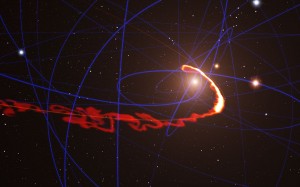
I’ve had black holes on the brain lately.* There’s been a flurry of related research announced lately, even the discovery of black hole-like vortexes in the Atlantic Ocean, and astronomers are keenly watching as a gas cloud is ripped apart by the monster black hole at the center of our galaxy. All of which has prompted me to think about the odd simplicity of how black holes work.
The irony is that black holes are also among the most puzzling objects in the universe, because theorists understand so little about their insides. What happens to the information that is lost when objects fall across the event horizon? What happens to the laws of physics at the singularity in the center? Can black holes create wormholes across space and time? Those internal oddities are so incomprehensible that Albert Einstein did not believe that black holes were a real physical possibility. Which makes it a little confusing to read articles about how Einstein might have been wrong about how black holes work, since he didn’t think they worked at all.
But on the outside, mass, spin, and charge tell you everything there is to observe about a black hole. Practically speaking, most black holes probably have very little net charge, so you could plausibly pare the list to mass and rotation. Even rotation has little impact if you are considering a black hole from a great distance–which, for your sake, I certainly hope you are. Viewed from afar, then, a black hole is a one-attribute object. Mass is the one and only thing you need to know.
Which brings me to another profoundly strange and simple thing about black holes. For an ordinary sphere–a bowling ball, for example–the mass increases as the cube of the radius. If one bowling ball is twice the diameter of another it will weigh eight times (2 cubed) as much. The rule breaks down a bit for large objects like planets, but in a very straightforward way. Their incredible bulk compresses their insides, so as planets get more massive their interiors tend to get more dense, assuming you are making an apples-to-apples comparison of the same type of planet. Some planets around other stars have masses several times that of Jupiter, but they are similar in size because of this gravitational squishing.
Black holes do something completely different, however. Their radius increases in direct proportion to the mass. Double the mass of a black hole, and its diameter doubles as well. (I’m using the event horizon–the point-of-no-return that defines the shape of the black hole–as its “surface” in this discussion.) The math of calculating the diameter of a black hole could not be easier. A black hole with the mass of the sun has a diameter of about 6 kilometers, or 4 miles. Want to know the diameter of the black hole at the center of the Milky Way? Based on the motions of stars circling around it, the black hole has a mass of 3.6 million suns. Just multiply 4 x 3.6 million and you’ve got your answer: It is 14 million miles wide.
The direct relationship between size and mass has a funny effect. The more massive a black hole is, the less dense it is–and the dropoff happens rapidly, as the square of the radius. (Again, I’m using the event horizon to define the surface of the black hole.) A solar-mass black hole crams the sun’s entire 865,000-mile-wide bulk into that 4-mile wide sphere, corresponding to a density 18 quadrillion times the density of water. It’s a staggering number. The black hole at the center of the Milky Way has a mass of 3.6 million suns, which means its density is (3.6 million x 3.6 million) times lower. That translates to about 1,400 times the density of water–still very high, and more than 100 times the density of lead, but no longer so incomprehensible.
Other black holes are much more massive than the central one in our galaxy, though, which means they are also much puffier. The galaxy M87 contains a monster black hole that astronomers have measured as having the mass of 6.6 billion suns. Its density is about 1/3,000th the density of water. That is similar to the density of the air you are breathing right now!
Now to the most mind-blowing part. If you keep going to higher masses, the radius of the black hole keeps growing and the density keeps shrinking. Let’s examine the most extreme case: What is the radius of a black hole with the mass of the entire visible universe? Turns out that its radius is…the same as the radius of the visible universe. Almost as if the entire universe is just one huge black hole.
Want to know what life looks like inside a black hole? Look around. You’re soaking in it.
* If you ask my wife she’ll tell you I’ve had black holes on the brain for at least as long as we’ve been married, but that’s a whole other story.
Was this news helpful?
2,963 people liked this